

By Isis Tiger O’Flynn-Shahaf
Picture this: you’re 75 years old, live alone, and aren’t very physically active. One day, you fall down your stairs and fracture a hip. You have to get surgery and spend the next few years in a nursing home. You’re told by your doctors that your bone density is extremely low which is what led to the hip fracture. You wonder what that even means and remember all the milk you’ve drank and yogurt you’ve eaten, thinking “Surely I’ve had enough calcium in my lifetime.” Maybe it’s genetic, maybe you could have taken peptides. Your doctor asks you about your lifestyle and your physical activity levels. You tell the doctor that you used to walk a lot and you played sports in high school, but that’s about it. Your doctor asks if you’ve ever tried weight lifting, to which you laughed and said no, of course not. Turns out, if you had started strength training even just ten years ago, your bone density would have been higher and your risk of a fracture would have gone down exponentially.
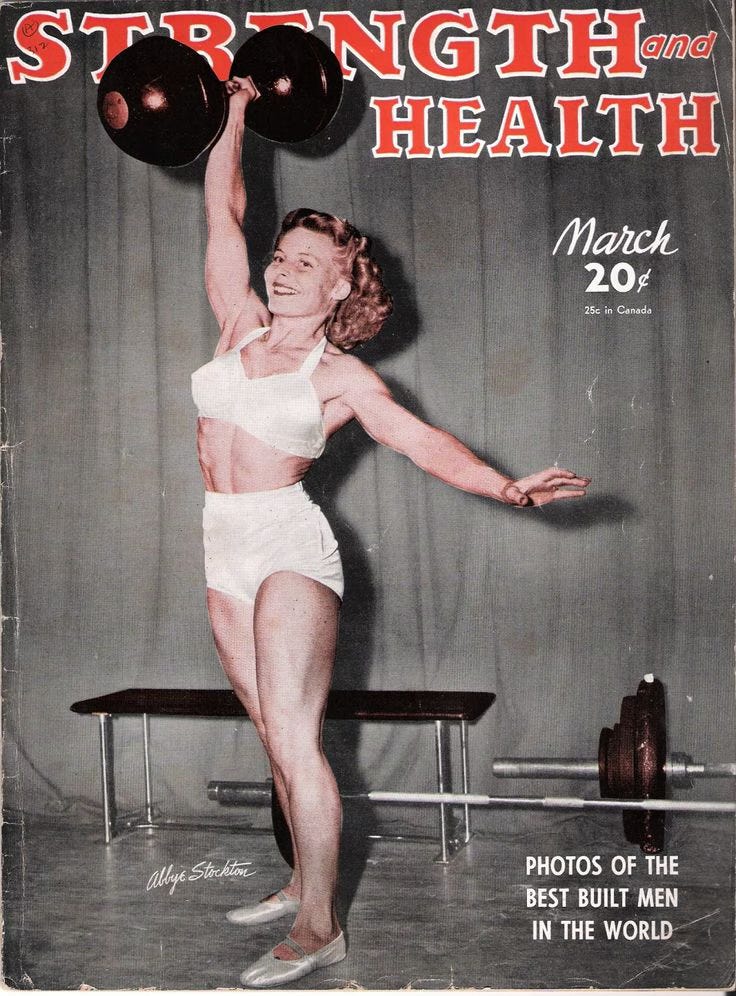
Unfortunately, this is the future for most women who don’t participate in strength training throughout their life. Dr. Ethan Kellum, an orthopedic surgeon based in Tennessee, sees many women in his clinic with deteriorated and fragile bones. “As you get older, you lose one to two percent of bone density every year,” he told REVAMPED. “Because you don’t have the muscle mass and your bone is already weak, you fall, and you break things.”
The mortality rate after a hip fracture in older adults is approximately 7% to 10% at 30 days, 15% to 25% at 6 months, and 20% to 30% at one year. Research shows that six months after hip fracture, only 8% could climb a flight of stairs. Weight lifting is not just about wanting to gain a lot of muscle and look a certain way, it’s about improving quality of life and making sure that as we age, we retain as much bodily autonomy as possible.
“Most people don’t think about bones,” Kellum said. “The bone is a living tissue, and there’s a cell type called the Osteoblast that builds the bone. It responds very well to stress signals, so when you lift those heavy weights, cells detect that and say ‘Oh, I gotta get bigger, I gotta get stronger’.”
Lavanya Kethamukkala, a 50 year-old functional dietician based in North Carolina, started weight lifting around five years ago. Before then, she had never strength trained and had only walked as her main form of exercise. “It’s not just about the number on the scale,” she said. “It’s how strong you are and how independent you are. I don’t want to be in a wheelchair or in a nursing home debilitated.” As a dietician in a nursing home nearby, she sees these types of people all the time. “We have more women residents than men in the nursing home, and most of them are coming with hip fractures.”
Women hit their peak bone mass around age 30. So, instead of waiting until after that point – when hormones start to change and life becomes more difficult to manage – why not start lifting weights now, when your body is more adaptable to change and has better recovery? Why not start the process while you’re at your most capable?
“It’s really important to start lifting weights early because you can bank the bone, so to speak. If you continue to do that, it will keep you out of trouble as far as osteoporosis,” said Dr. Kellum to REVAMPED. Especially during and after menopause when estrogen levels start to drop, it’s vital that women are strength training to prevent the onset of osteoporosis. Unfortunately, many women are uninformed about the importance of weight training until it’s too late. Kethamukkala often sees this at her nursing home. “They were never told that this is a part of the whole game,” she said. “You would be surprised that every woman I talk to, maybe other than health professionals, have no clue about all of this.”
The message is clear: don’t wait until it’s too late. Pick up the weights and start lifting. If you’re unsure of how to start, hire a coach to help you. It can seem unimportant to start strength training when you’re in your 20’s and your body feels great, but without proper conditioning, that feeling fades. It’s more than how you look. It’s about being able to grow old and continue to participate in activities within your community and, more importantly, have independence with your own body. Plus, you’ll look great too.
Can’t wait to put this on my weekly wrap up